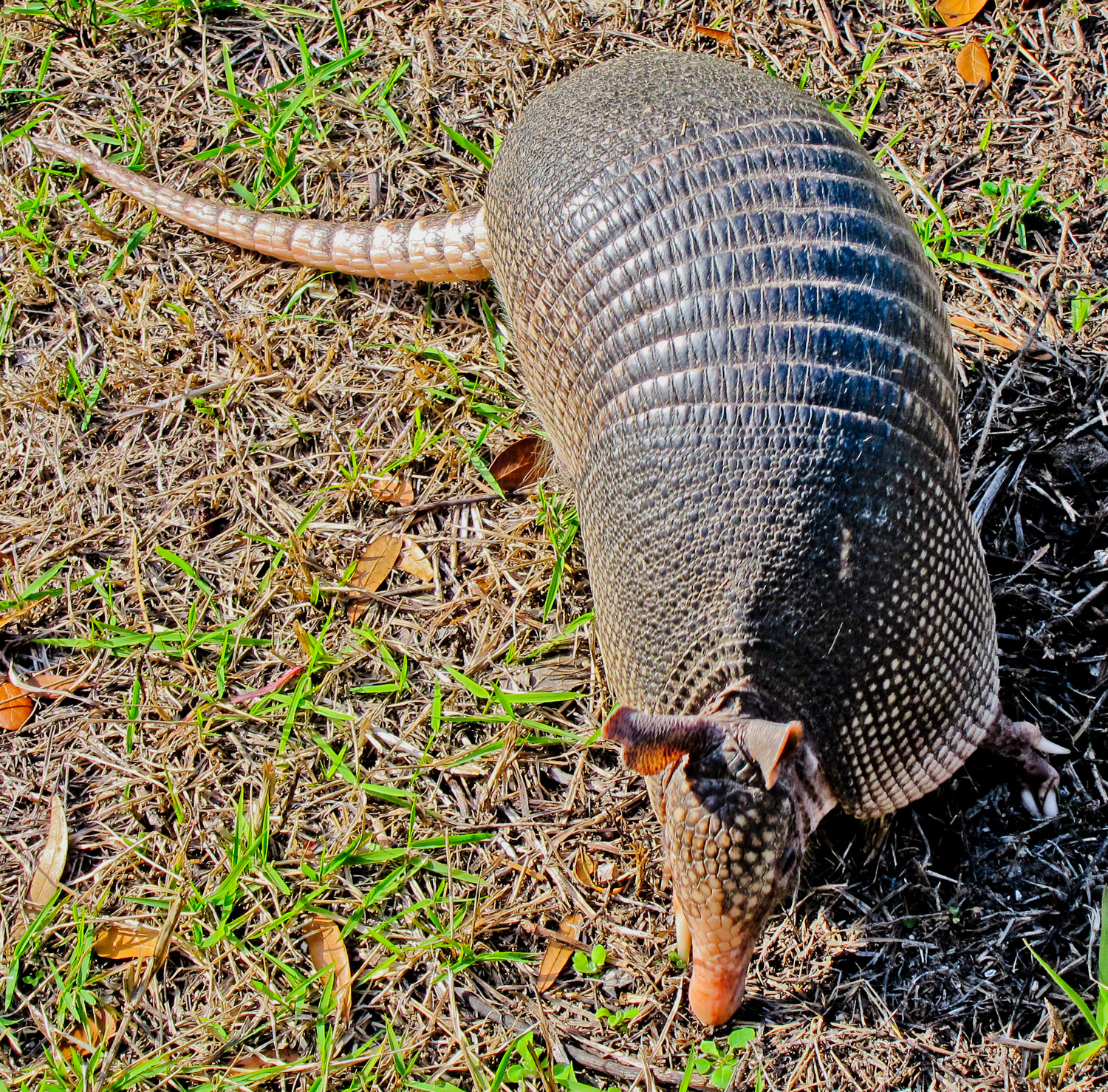
As the golden sun begins its descent over Florida’s diverse landscapes, a peculiar figure shuffles through the underbrush, its armored body glinting in the fading light. This is the nine-banded armadillo (Dasypus novemcinctus), an unexpected yet fascinating inhabitant of the Sunshine State. With its unique appearance and curious habits, the armadillo has become a symbol of resilience and adaptability. Join me on a journey into the world of the nine-banded armadillo, exploring its habits, habitats, and the vital role it plays in Florida’s ecosystems.
A Creature of Curiosity
The nine-banded armadillo is one of the most distinctive mammals in Florida. Named for the nine bands of armor that cover its body, this nocturnal creature is easily recognizable. Its armor consists of bony plates covered in a leathery skin, providing protection from predators and rough terrain. Despite their tough exterior, armadillos are surprisingly agile and capable diggers.
Armadillos are solitary animals, primarily active at night when they forage for food. They have poor eyesight but an excellent sense of smell, which they use to locate insects, grubs, and other invertebrates hidden beneath the soil. Their long, sticky tongues are perfectly adapted for extracting prey from narrow crevices.
Habitat and Range
The nine-banded armadillo is a versatile creature, capable of thriving in a variety of habitats. In Florida, they can be found in forests, grasslands, scrublands, and even suburban areas. They prefer environments with loose, sandy soil that is easy to dig, as burrowing is a key aspect of their behavior.
Armadillos dig extensive burrow systems that serve as homes, foraging grounds, and refuges from predators and extreme weather. These burrows can be quite complex, with multiple entrances and chambers. The loose soil around these burrows can sometimes be seen near the surface, marking the presence of an armadillo beneath.
The range of the nine-banded armadillo has expanded significantly over the past century. Originally native to South and Central America, they have steadily moved northward, now found as far north as the Midwest United States. In Florida, they are well-established and continue to thrive.
Diet and Foraging Habits
The nine-banded armadillo has a varied diet, with a preference for insects and other invertebrates. Their foraging habits play a crucial role in controlling insect populations, making them valuable to the ecosystem. Armadillos use their strong forelimbs and sharp claws to dig into the soil, unearthing beetles, ants, termites, and other small creatures.
In addition to insects, armadillos also consume a variety of plant materials, including fruits, seeds, and tubers. Their opportunistic feeding behavior allows them to adapt to seasonal changes in food availability, ensuring they can find nourishment year-round.
One of the most fascinating aspects of armadillo foraging is their method of locating food. With poor vision, they rely heavily on their keen sense of smell. As they move through their habitat, they constantly sniff the ground, detecting the faint scents of hidden prey. Once a scent is found, they use their claws to dig rapidly, often leaving distinctive cone-shaped holes in their wake.
Physical Adaptations and Characteristics
The nine-banded armadillo is a marvel of adaptation, with physical characteristics that make it well-suited to its environment. Its most notable feature is its armor, which consists of bony plates known as osteoderms. These plates are covered by a tough, leathery skin that provides protection from predators and rough terrain.
Armadillos have a cylindrical body with short, sturdy legs. Their forelimbs are equipped with powerful claws that are ideal for digging. Despite their heavy armor, they are surprisingly agile, capable of swimming across rivers and climbing short distances to reach food or escape danger.
One of the armadillo’s unique adaptations is its ability to hold its breath for extended periods. This allows them to dig burrows that are several feet deep without the risk of suffocation. Their burrowing behavior not only provides them with shelter but also benefits the ecosystem by aerating the soil and creating habitats for other animals.
Reproduction and Lifespan
The reproductive cycle of the nine-banded armadillo is a fascinating process, marked by unique biological traits. Mating typically occurs during the summer months, with females capable of delayed implantation. This means that after mating, the fertilized egg does not immediately implant in the uterus, allowing the female to time the birth of her young to coincide with favorable environmental conditions.
After a gestation period of about four months, the female gives birth to a litter of four genetically identical offspring. This is because the fertilized egg splits into four embryos, resulting in quadruplets that share the same genetic makeup. The young armadillos are born fully formed, with their eyes open and a soft version of their characteristic armor, which hardens over time.
Young armadillos remain with their mother for a few months, learning essential survival skills before venturing out on their own. In the wild, nine-banded armadillos have a lifespan of about seven to 20 years, although they can live longer in captivity.
The Role in the Ecosystem
Nine-banded armadillos play a crucial role in maintaining the health of Florida’s ecosystems. As insectivores, they help control populations of insects and other invertebrates, which can benefit agricultural and natural environments. Their foraging activities also aid in soil aeration, promoting healthy plant growth.
Armadillos are important prey for a variety of predators, including bobcats, coyotes, and birds of prey. Their burrows provide shelter not only for themselves but also for other animals, such as snakes, rodents, and small mammals, contributing to the overall biodiversity of their habitat.
Human Interaction and Conservation
The relationship between humans and nine-banded armadillos in Florida is complex. While these unique creatures are generally harmless, they can sometimes be considered pests, particularly when they dig up lawns, gardens, or golf courses in search of food. Their burrowing behavior can also cause structural damage to buildings and roads if left unchecked.
Despite these challenges, armadillos are protected by law in many areas, and efforts are made to mitigate human-wildlife conflicts. Conservation efforts focus on preserving natural habitats and promoting coexistence through public education and awareness. By understanding the ecological benefits that armadillos provide, we can learn to appreciate these fascinating creatures and find ways to live alongside them.
A Personal Encounter
One of my most memorable encounters with a nine-banded armadillo occurred during a late afternoon hike in the Ocala National Forest. As I walked quietly through the forest, the rustling of leaves caught my attention. I looked down to see an armadillo busily foraging, its snout buried in the soil.
I stood still, observing the armadillo as it dug with remarkable speed and precision. Its armor glinted in the dappled sunlight, and I marveled at the efficiency of its movements. After a few moments, the armadillo paused, lifting its head to sniff the air. Our eyes met briefly before it resumed its foraging, seemingly unbothered by my presence.
This encounter left me with a deep appreciation for the nine-banded armadillo’s resilience and adaptability. It is moments like these that remind us of the intricate beauty of Florida’s natural world and the importance of protecting it for future generations.
The Future of Nine-Banded Armadillos in Florida
The future of nine-banded armadillos in Florida depends on our ability to balance development with conservation. As urban areas expand and land use changes, it is essential to prioritize the protection of natural habitats and promote sustainable practices that support the health of these ecosystems.
Public engagement and education are critical components of armadillo conservation. By fostering a greater understanding and appreciation for these animals, we can encourage responsible behaviors that minimize human impact on their habitats. Simple actions, such as protecting natural areas, reducing pesticide use, and advocating for stronger environmental protections, can make a significant difference.
Research and monitoring efforts continue to play a key role in conservation. By studying armadillo populations, behavior, and habitat use, biologists can develop effective strategies to protect these animals. Collaboration between government agencies, conservation organizations, and local communities is essential in ensuring the success of these efforts.
Conclusion: Guardians of the Underbrush
The nine-banded armadillo is more than just a peculiar resident of Florida’s landscapes; it is a guardian of the underbrush, embodying the resilience and adaptability that define the natural world. From the forests and grasslands to the suburban edges, these armor-clad wanderers navigate their territories with a quiet determination that captivates and inspires.
As we continue to explore and appreciate the beauty of Florida’s natural areas, let us remember the nine-banded armadillo and the vital role it plays in our environment. By understanding and respecting these remarkable creatures, we can ensure they remain a vibrant part of our natural world for generations to come.
In the end, the story of the nine-banded armadillo is a story of nature itself – one of resilience, adaptation, and the enduring beauty of the wild. So the next time you find yourself wandering through Florida’s diverse landscapes, keep an eye out for the telltale rustle of leaves or the distinctive tracks of an armadillo, a reminder of the untamed spirit that still thrives in our midst.
| Nine-banded armadillo | |
|---|---|
,_Uruguay,_2020.jpg)
| |
| Nine-banded armadillo in Uruguay | |
Scientific classification 
| |
| Kingdom: | Animalia |
| Phylum: | Chordata |
| Class: | Mammalia |
| Order: | Cingulata |
| Family: | Dasypodidae |
| Genus: | Dasypus |
| Species: | D. novemcinctus
|
| Binomial name | |
| Dasypus novemcinctus | |
| Synonyms[2] | |
|
Tatusia novemcincta (Linnaeus, 1758) | |


The nine-banded armadillo (Dasypus novemcinctus), also called the nine-banded long-nosed armadillo or common armadillo, is a species of armadillo native to South America.[3] The Mexican long-nosed armadillo of North America was formerly treated as a subspecies of the nine-banded armadillo.
The nine-banded armadillo is a solitary, mainly nocturnal[4][5] animal, found in many kinds of habitats, from mature and secondary rainforests to grassland and dry scrub. It is an insectivore, feeding chiefly on ants, termites, and other small invertebrates. The armadillo can jump 91–120 cm (3–4 ft) straight in the air if sufficiently frightened, making it a particular danger on roads.[6]
Subspecies
- D. n. aequatorialis Lönnberg, 1913
- D. n. fenestratus Peters, 1864
- D. n. hoplites Allen, 1911
- D. n. mexianae (Hagmann, 1908)
- D. n. novemcinctus Linnaeus, 1758
Description
._.jpg)
Nine-banded armadillos generally weigh from 2.5–6.5 kg (5.5–14.3 lb), though the largest specimens can scale up to 10 kg (22 lb). They are one of the largest species of armadillos.[7] Head and body length is 38–58 cm (15–23 in), which combines with the 26–53 cm (10–21 in) tail, for a total length of 64–107 cm (25–42 in). They stand 15–25 cm (5.9–9.8 in) tall at the top of the shell.[7][8] The outer shell is composed of ossified dermal scutes covered by nonoverlapping, keratinized epidermal scales, which are connected by flexible bands of skin. This armor covers the back, sides, head, tail, and outside surfaces of the legs. The underside of the body and the inner surfaces of the legs have no armored protection. Instead, they are covered by tough skin and a layer of coarse hair. The vertebrae attach to the carapace.[9] The claws on the middle toes of the forefeet are elongated for digging, though not to the same degree as those of the much larger giant armadillo of South America.[10] Their low metabolic rate and poor thermoregulation make them best suited for semitropical environments.[9] Unlike the South American three-banded armadillos, the nine-banded armadillo cannot roll itself into a ball. It is, however, capable of traversing rivers by inflating its intestines and floating, or by sinking and running across the riverbed. The second is possible due to its ability to hold its breath for up to six minutes, an adaptation originally developed for allowing the animal to keep its snout submerged in soil for extended periods while foraging.[9] Although nine is the typical number of bands on the nine-banded armadillo, the actual number varies by geographic range.[9] Armadillos possess the teeth typical of all sloths and anteaters. The teeth are all small, peg-like molars with open roots and no enamel. Incisors do form in the embryos, but quickly degenerate and are usually absent by birth.[9]
Habitat
The nine-banded armadillo evolved in a warm, rainy environment, and is still most commonly found in regions resembling its ancestral home. As a very adaptable animal, though, it can also be found in scrublands, open prairies, and tropical rainforests. It cannot thrive in particularly cold or dry environments, as its large surface area, which is not well insulated by fat, makes it especially susceptible to heat and water loss.[10]
Range
The nine-banded armadillo ranges through most of South America except for the Guiana Shield area where the Guianan long-nosed armadillo Dasypus guianensis, a new species of armadillo officially described in June 2024, exists.[11]
Diet
Nine-banded armadillos are generally insectivores. They forage for meals by thrusting their snouts into loose soil and leaf litter and frantically digging in erratic patterns, stopping occasionally to dig up grubs, beetles (perhaps the main portion of this species' prey selection), ants, termites, grasshoppers, other insects, millipedes, centipedes, arachnids, worms, and other terrestrial invertebrates, which their sensitive noses can detect through 8 in (20 cm) of soil.[12][13] They then lap up the insects with their sticky tongues. Nine-banded armadillos have been observed to roll about on ant hills to dislodge and consume the resident ants. They supplement their diets with amphibians and small reptiles, especially in more wintery months when such prey tends to be more sluggish, and occasionally bird eggs and baby mammals. Carrion is also eaten, although perhaps the species is most attracted to the maggots borne by carcasses rather than the meat itself. Less than 10% of the diet of this species is composed by nonanimal matter, though fungi, tubers, fruits, and seeds are occasionally eaten.[14][15]
Behavior
Nine-banded armadillos are solitary, largely nocturnal animals that come out to forage around dusk. They are extensive burrowers, with a single animal sometimes maintaining up to 12 burrows on its range. These burrows are roughly 20 cm (8 in) wide, 210 cm (7 ft) deep, and 760 cm (25 ft) long. Armadillos mark their territory with urine, feces, and excretions from scent glands found on the eyelids, nose, and feet. Males hold breeding territories and may become aggressive in order to keep other males out of their home range to increase chances of pairing with a female.[16] Territorial disputes are settled by kicking and chasing. When they are not foraging, armadillos shuffle along fairly slowly, stopping occasionally to sniff the air for signs of danger.
Predation
If alarmed, nine-banded armadillos can flee with surprising speed. Occasionally, a large predator may be able to ambush the armadillo before it can clear a distance, and breach the hard carapace with a well-placed bite or swipe. If the fleeing escape fails, the armadillo may quickly dig a shallow trench and lodge itself inside. Predators are rarely able to dislodge the animal once it has burrowed itself, and abandon their prey when they cannot breach the armadillo's armor or grasp its tapered tail.[10] Due to their softer carapaces, juvenile armadillos are more likely to fall victim to natural predation and their cautious behavior generally reflects this. Young nine-banded armadillos tend to forage earlier in the day and are more wary of the approach of an unknown animal (including humans) than are adults. Their known natural predators include cougars (perhaps the leading predator), maned wolves, jaguars, and large raptors. Many thousands fall victim to roadkill caused by auto accidents every year.[17][18]
Reproduction
Mating takes place during a two-to-three month long mating season, which occurs from November–January. A single egg is fertilized and develops into a blastocyst, but implantation is delayed for three to four months to ensure the young will not be born during an unfavorable time. Once the blastocyst does implant in the uterus it splits into four identical embryos via collapse of the common amnion and subsequent division of the embryonic shield.[19] Each of the four embryos has a separate amnion and umbilical cord,[20] but all four are attached to a common placenta.[21] The gestation period is four months. At birth, they weigh 85 g (3 oz).[22] After birth, the quadruplets remain in the burrow, living off the mother's milk for about three months. They then begin to forage with the mother, eventually leaving after six months to a year.[10][9]
Nine-banded armadillos reach sexual maturity at the age of one year, and reproduce every year for the rest of their 12-to-15-year lifespans. A single female can produce up to 56 young over the course of her life. This high reproductive rate is a major cause of the species' rapid expansion.[10]
Effect on the environment
The foraging of nine-banded armadillo can cause mild damage to the root systems of certain plants. Skunks, cotton rats, burrowing owls, and rattlesnakes can be found living in abandoned armadillo burrows.[10]
They are typically hunted for their meat, which is said to taste like pork, but are more frequently killed as a result of their tendency to steal the eggs of poultry and game birds. This has caused certain populations of the nine-banded armadillo to become threatened, although the species as a whole is under no immediate threat.[10] They are also valuable for use in medical research, as they are among the few mammals other than humans susceptible to leprosy.[9]
See also
- Mexican long-nosed armadillo, recently elevated from a subspecies of the nine-banded armadillo.
References
- ^ Loughry, J.; McDonough, C.; Abba, A.M. (2014). "Dasypus novemcinctus". IUCN Red List of Threatened Species. 2014 e.T6290A47440785. doi:10.2305/IUCN.UK.2014-1.RLTS.T6290A47440785.en. Retrieved November 19, 2021.
- ^ "Dasypus novemcinctus Linnaeus, 1758". Global Biodiversity Information Facility. Retrieved October 29, 2024.
- ^ "Dasypus novemcinctus". mammaldiversity.org. The MDD Team. Retrieved March 6, 2026.
- ^ Armadillo Observation. Msu.edu. Retrieved on October 17, 2013.
- ^ Mammals of Kansas – Kansas University Archived April 26, 2012, at the Wayback Machine. Ksr.ku.edu. Retrieved on October 17, 2013.
- ^ "How high can a nine-banded armadillo jump?". Everyday Mysteries. Library of Congress. (dead link 2 November 2024)
- ^ a b 3.8 Armadillos. Fao.org. Retrieved on October 17, 2013.
- ^ Burnie D and Wilson DE (Eds.) (2005) Animal: The Definitive Visual Guide to the World's Wildlife. DK Adult, ISBN 0789477645
- ^ a b c d e f g Feldhamer, George A.; Lee C. Drickhamer; Stephen H. Vessey; Joseph F. Merritt; Carey Krajewski (2007). Mammalogy: Adaptation, Diversity, Ecology. Baltimore, Maryland: Johns Hopkins University Press. ISBN 978-0-8018-8695-9.
- ^ a b c d e f g Wildlife Explorer: Nine-Banded Armadillo. USA: International Masters Publishers, 1998.[dubious – discuss]
- ^ "Widespread Armadillo Is Actually Four Different Species". Field Museum. Retrieved March 6, 2026.
- ^ "Dasypus novemcinctus (Nine-banded armadillo)". Animal Diversity Web.
- ^ Hailey, A. "Dasypus novemcinctus(Nine-banded Armadillo or Tatu)" (PDF). UWI St. Augustine. Retrieved December 16, 2023.
- ^ Chapman, J. and Feldhamer, G. (1982) Wild Mammals of North America: Biology, Management, and Economics, Johns Hopkins University Press, ISBN 0801823536.
- ^ Schmidly, D. and William, D. (2004) "Nine-banded Armadillo" Archived May 16, 2016, at the Wayback Machine in The Mammals of Texas. Austin: University of Texas Press, ISBN 0292702418.
- ^ McDonough, Colleen M. (January 1, 1997). "Pairing Behavior of the Nine-banded Armadillo (Dasypus novemcinctus)". The American Midland Naturalist. 138 (2): 290–298. doi:10.2307/2426822. JSTOR 2426822.
- ^ Moeller, W. (1990) "Modern Xenarthrans", pp. 583–626 in S Parker (ed.) Grzimek's Encyclopedia of Mammals, Vol. 2, English Language Edition. New York: McGraw-Hill, Inc., ISBN 0079095089
- ^ Weckel, M.; Giuliano, W.; Silver, S. (2006). "Cockscomb Revisited: Jaguar Diet in the Cockscomb Basin Wildlife Sanctuary, Belize1". Biotropica. 38 (5): 687. Bibcode:2006Biotr..38..687W. doi:10.1111/j.1744-7429.2006.00190.x. S2CID 85151201.
- ^ Enders, Allen. 2002. Implantation in the Nine-banded Armadillo: How Does a Single Blastocyst Form Four Embryos? Placenta. 23: 71-85. doi:10.1053/plac.2001.0753
- ^ Leao, Delva P., et al. 2024. What makes each of us unique? The nine-banded armadillo as a model to study individuality. Frontiers in Mammalian Sciences. 3: 01-08. doi: 10.3389/fmamm.2024.1450655
- ^ The Mammals of Texas, Davis and Schmidly 1994
- ^ Field guide to mammals. 1996. ISBN 0-679-44631-1
Further reading
- Emmons, Louise H.; Feer, François (September 2, 1997). Neotropical rainforest mammals. A field guide (2nd ed.). Chicago: University of Chicago Press. pp. 49–50. ISBN 978-0-226-20721-6. OCLC 44179508.
- eNature entry
- Nixon, Joshua. Armadillo Expansion, September 14, 2006, retrieved December 3, 2006.
- Trapping the nine-banded armadillo Archived April 23, 2011, at the Wayback Machine
External links
- View the nine-banded armadillo genome in Ensembl
- View the dasNov3 genome assembly in the UCSC Genome Browser
| National | |
|---|---|
| Other | |
